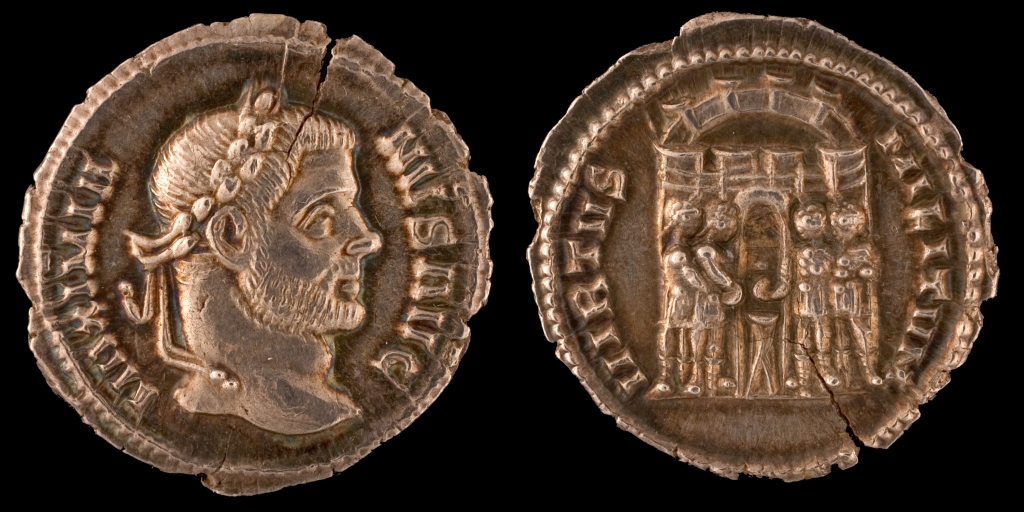
Silver Argenteus of Maximian, 2.79 g.
Title
Silver Argenteus of Maximian, 2.79 g.
Creator
Maximian
Date
c. 294 CE
Description
Obverse: Laureate head of Maximian facing right; MAXIMIANVS AVG(VSTVS): Maximianus Augustus.
Reverse: Tetrarchs sacrificing over tripod before arch in eight-turreted enclosure; VIRTVS MILITVM: the valour of the army.
Style/Period: Roman Empire
When Diocletian was proclaimed emperor in 284 CE, he put Maximian in charge of the West and quickly elevated him first to the rank of Caesar and then to Augustus. Maximian dealt with German invasions and rebellion in Gaul while Diocletian remained in the East to fight the Persians. In 293 CE Diocletian put into effect his plan to reorganize and stabilize the administration of the empire and to strengthen its frontiers by establishing the tetrarchy or rule of four, in which there were to be two senior emperors, the Augusti, and two junior colleagues, the Caesares, each of whom was assigned responsibility for one area of the empire. Diocletian and Maximian remained the Augusti, and Diocletian appointed Constantius and Galerius Caesares. The next year he introduced major financial reforms, including important changes in the coinage, one of which was the introduction of a fine silver coin called the argenteus. This coin is a typical example of the new denomination.
Most of the types on the argentei are military, designed to appeal to the troops that were paid with the coins. The obverse portrait of Maximian is the typical military type with short hair and beard; the type on Diocletian's coins is virtually identical, the similarity probably a means of expressing the concord and unity of the tetrarchs. The same idea is conveyed by the reverse, on which the four rulers sacrifice together before a gateway fortified with towers.
-- Benjamin Hayes, LU '93
Bibliography: C.H.V. Sutherland, The Roman Imperial Coinage VI: from Diocletian's reform (A.D. 294) to the death of Maximianus (A.D. 313) (London 1967) Siscia 32b.
Source
Former collection of Ottilia Buerger. Purchased from Fred Knobloch, Jan. 1968
Identifier
91.236
Rights
Wriston Art Center Galleries, Lawrence University, Appleton, WI,wriston-gallery@lawrence.edu,920-832-6890
Subject
Roman, Empire, Maximian, Tetrarchs, scrifice, tripod, arch
Files
Citation
Maximian, “Silver Argenteus of Maximian, 2.79 g.,” Lawrence University Classics Department & Ottilia Buerger Coin Collections, accessed November 5, 2026, https://thor.lawrence.edu/omeka/buerger/items/show/313.