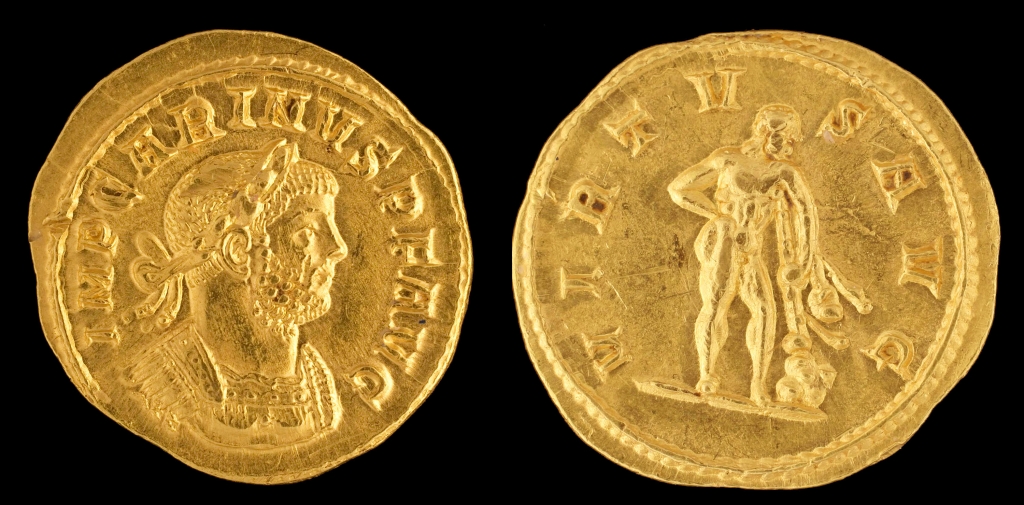
Gold Aureus of Carinus, 4.52 g.
Title
Gold Aureus of Carinus, 4.52 g.
Creator
Carinus
Date
284 CE
Description
Obverse: Laureate and cuirassed bust of Carinus facing right; IMP(ERATOR) CARINVS P(IVS) F(ELIX) AVG(VSTVS): Imperator Carinus, pious, fortunate Augustus.
Reverse: Nude Hercules standing facing right, leaning on club; VIRTVS AVG(VSTI): Virtus of the Augustus.
Style/Period: Roman Empire
Marcus Aurelius Carinus, son of the emperor Carus, was made Caesar shortly after his father's accession in 282 CE, at about the age of thirty-three. He was put in charge of the troops in the West while his father went to the East on a campaign against the Persians. In 283 CE he and his brother, Numerian, were elevated to the rank of Augustus, and shortly afterward their father was killed, reportedly struck by lightning. When Numerian was murdered on the way back from Persia in 284 CE, Carinus became sole emperor. Meanwhile, Diocletian had been proclaimed emperor by his troops, and he marched against Carinus. They met in a battle at Margus in Moesia, which was won by Carinus, but he was murdered on the battlefield by one of his men whose wife he had seduced.
The portrait of Carinus on the obverse of this aureus reverts to the standard military type of the third-century emperors, with very short hair and beard, but like the portraits of Postumus (see 91.227) and Probus (see 91.232), it also depicts an elaborate cuirass. The reverse, celebrating the Virtus of the emperor, depicts Hercules with his most common attributes, the club and lionskin. These refer to one of his twelve labors, in which he killed the lion that the goddess Juno had sent to destroy him.
-- Carol L. Lawton
Bibliography: P.H. Webb, The Roman Imperial Coinage V.2 (London 1933) 233.
Source
Former collection of Ottilia Buerger. Purchased from Abner Kreisberg, November 4, 1960.
Identifier
91.233
Rights
Wriston Art Center Galleries, Lawrence University, Appleton, WI,wriston-gallery@lawrence.edu,920-832-6890
Subject
Roman, Empire, cuirass, Cariuns, Hercules, club
Files
Citation
Carinus, “Gold Aureus of Carinus, 4.52 g.,” Lawrence University Classics Department & Ottilia Buerger Coin Collections, accessed November 5, 2026, https://thor.lawrence.edu/omeka/buerger/items/show/311.