(Copper/bronze/brass) Medallion of Philip I (Philip the Arab), 51.29 g.
Title
(Copper/bronze/brass) Medallion of Philip I (Philip the Arab), 51.29 g.
Creator
Philip I (Philip the Arab)
Date
248 CE
Description
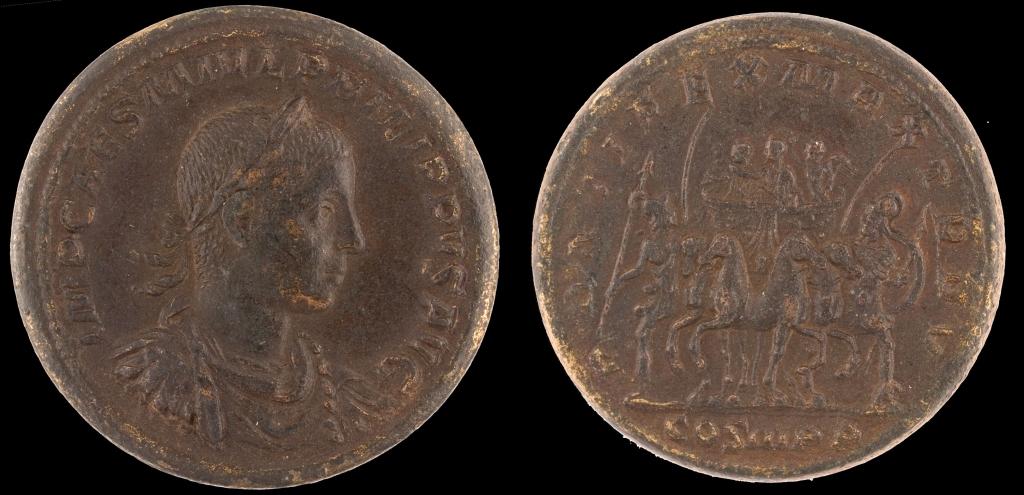
Obverse: Laureate, draped, and cuirassed bust of Philip II facing right; IMP(ERATOR) CAES(AR) M(ARCVS) IVL(IVS) PHILIPPVS AVG(VSTVS): Imperator Caesar Marcus Iulius Philippus Augustus.
Reverse: In a facing quadriga led by two soldiers, each with spear and shield, Philip I, holding branch and crowned by Victoria, and Philip II, with right hand extended; PONTIFEX MAX(IMVS) TR(IBVNICIA) P(OTESTATE) V: pontifex maximus, with tribunician power for the fifth time; in exergue, CO(N)S(VL) III P(ATER) P(ATRIAE): consul for the third time, father of the country.
Style/Period: Roman Empire
Marcus Julius Philippus was born in the Roman province of Arabia and is thus often called Philip the Arab. In 243 CE he became praetorian prefect under the young emperor Gordian III, whom he murdered within a year. He made peace with the Persians, who had invaded Roman territory under Gordian, and set about building a dynasty on the model of the Antonines and Severans. He made his son, Philip, Caesar in 244 CE and, although he was still very young, shared the consulate with him and raised him to the rank of Augustus in 247 CE. Philip did not live to carry out his plans, however, because the troops at the Danube proclaimed a reluctant Decius emperor, and Philip died when Decius engaged him in battle at Verona in 249 CE. Philip II was killed at about the same time.
In 245 CE the German Carpi attacked the frontier and engaged Philip's troops until 247 CE, when he returned in triumph to Rome. In a series of medallions in 247 CE and 248 he celebrated his great triumph, as well as the elevation of Philip II to Augustus that accompanied it. Father and son are crowned by Victoria in their triumphal chariot. Although the titles on the reverse belong to Philip I, the beardless bust on the obverse depicts Philip II.
-- Carol L. Lawton
Bibliography: J.P.C. Kent, Roman Coins (London 1978) 311 no. 457 (similar reverse).
Source
Former collection of Ottilia Buerger. Purchased from Bank Leu, 7/6/1985.
Identifier
91.221
Rights
Wriston Art Center Galleries, Lawrence University, Appleton, WI,wriston-gallery@lawrence.edu,920-832-6890
Subject
Roman, Empire, quadriga, horse, soldiers, spear, shield, Philip I, Victoria, Philip II
Files
Citation
Philip I (Philip the Arab), “(Copper/bronze/brass) Medallion of Philip I (Philip the Arab), 51.29 g.,” Lawrence University Classics Department & Ottilia Buerger Coin Collections, accessed November 5, 2026, https://thor.lawrence.edu/omeka/buerger/items/show/306.