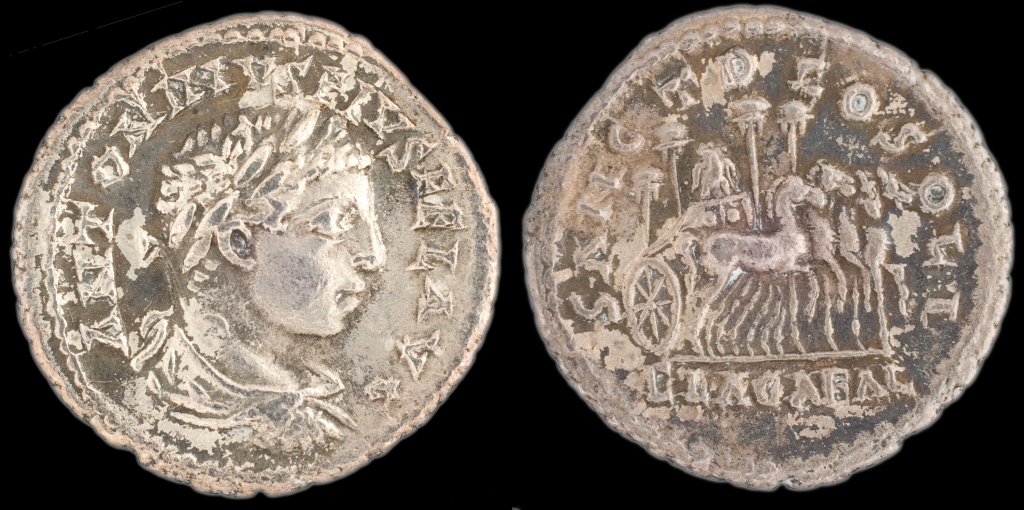
Silver Denarius of Elagabalus, 2.70 g.
Title
Silver Denarius of Elagabalus, 2.70 g.
Creator
Elagabalus
Date
218-222 CE
Description
Obverse: Laureate, draped, and cuirassed bust of Elagabalus facing right; ANTONINVS PIVS FEL(IX) AVG(VSTVS): Antoninus Pius, fortunate Augustus.
Reverse: Slow quadriga facing right, bearing conical stone of Emesa with eagle, surrounded by four parasols; SANCT(O) DEO SOLI, in exergue ELAGABAL(VS): to the sacred sun god, Elagabalus.
Style/Period: Roman Empire
Varius Avitus Bassianus was a great-nephew of Septimius Severus and the hereditary high priest of the sun god Elagabalus at Emesa in Syria. When Macrinus proved ineffectual, his troops were convinced to switch their allegience to the fifteen-year-old priest by his mother and grandmother, who claimed that he was the illegitimate son of Caracalla (see 91.201). They gave him the official name Marcus Aurelius Antoninus, the same name Caracalla took when his father claimed to be an Antonine, to legitimize his right to the throne. They escorted the new emperor to Rome, where his promotion of the strange rites of the cult of Elagabalus caused him to be known by the name of the god. He soon became notorious for extravagance and corruption and under the guise of his oriental cult engaged in such outrageous and licentious behavior that the public became disgusted. When he plotted against his cousin, Alexander Severus, whom his mother and the Senate had encouraged him to adopt and make Caesar, the army revolted and murdered Elagabalus and his mother.
The god Elagabalus was worshipped at Emesa in the form of a conical black stone, which was brought to Rome with the new emperor and enshrined in a temple of the sun god Sol on the Palatine. Once a year the stone was carried through the streets of Rome in a quadriga with parasols, preceded by Elagabalus walking backward in reverence of it. The quadriga carrying the stone is depicted on the reverse of a number of his coins.
-- Robin Emmanuel Bandy McNeill, LU '93
Bibliography: H. Mattingly, E.A. Sydenham, and C.H.V. Sutherland, The Roman Imperial Coinage IV.2: Macrinus to Pupienus (London 1936) 195.
Source
Former collection of Ottilia Buerger. Purchased from Coin Galleries auction, December 2, 1960.
Identifier
91.210
Rights
Wriston Art Center Galleries, Lawrence University, Appleton, WI,wriston-gallery@lawrence.edu,920-832-6890
Subject
Roman, Empire, Elagabalus, quadriga, stone of Emesa, eagle, parasol
Files
Citation
Elagabalus, “Silver Denarius of Elagabalus, 2.70 g.,” Lawrence University Classics Department & Ottilia Buerger Coin Collections, accessed November 5, 2026, https://thor.lawrence.edu/omeka/buerger/items/show/304.