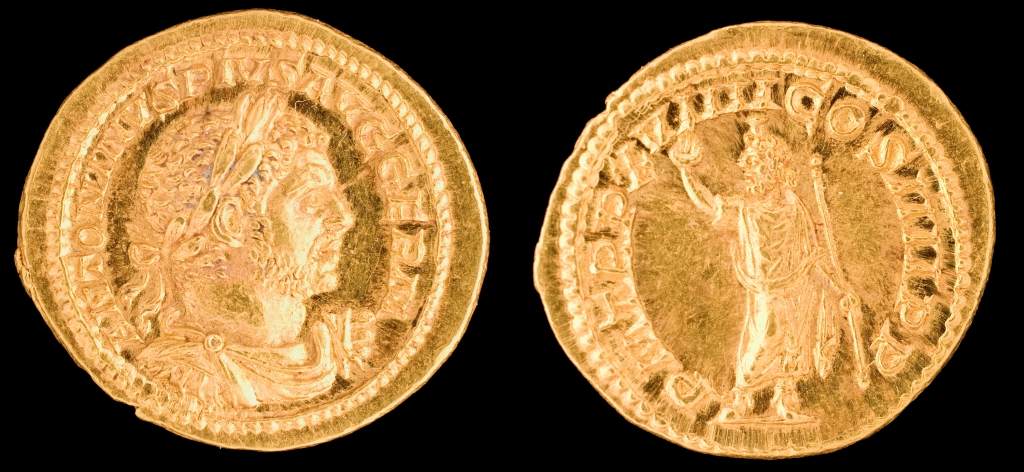
Gold Aureus of Caracalla, 6.55 g.
Title
Gold Aureus of Caracalla, 6.55 g.
Creator
Caracalla
Date
215 CE
Description
Obverse: Laureate, draped, and cuirassed bust of Antoninus facing right; ANTONINVS PIVS AVG(VSTVS) GERM(ANICVS): Antoninus Pius Augustus, conqueror of the Germans.
Reverse: Serapis standing facing left wearing modius, scepter in left hand, right raised.; P(ONTIFEX) M(AXIMVS) TR(IBVNICIA) P(OTESTATE) XVIIII CO(N)S(VL) IIII P(ATER) P(ATRIAE): Pontifex maximus, with tribunician power for the nineteenth time, consul for the fourth time, father of the country.
Style/Period: Roman Empire
Caracalla, so nicknamed by his troops for the Gallic cloak or caracallus that he wore, was born Julius Bassianus to Septimius Severus and Julia Domna in 188 CE. When his father claimed adoption by Marcus Aurelius in 195 CE, he changed his son's name to Marcus Aurelius Antoninus, which remained his official name. He was made Caesar in 196 CE and Augustus in 198 CE, the latter elevation coinciding with Severus' great victory over the Parthians (see 91.199). He ruled jointly with Severus until his death in 211 CE and then jointly with his brother, Geta, until he had him murdered in 212 CE. He fought a series of campaigns on the German frontier, where he acquired his nickname and took the title Germanicus, and in the East, where he aspired to be the new Alexander. The greatest monument to his reign are the opulent Baths of Caracalla in Rome, dedicated in 216 CE. Caracalla was popular with his troops, but his mental instability, his cruelty, and his hatred of the Senate resulted in a conspiracy, and he was murdered in 217 CE.
Caracalla rejected the philosopher-like portraiture of the Antonines for the look of a military man. He is shown with short hair and a close-cropped beard, and in his later portraits a V-shaped furrow in his brow produces a scowl that reflects his cruel and violent nature. The type would serve as a model for the portraits of the soldier-emperors of the third century.
Caracalla's father, Severus, had identified himself with the Egyptian god Serapis, probably primarily for his African associations, and Caracalla continued to honor his cult. His usual attribute is the modius, the Roman grain measure, which he wears as a headdress symbolizing his connections with fertility.
-- Robin Emmanuel Bandy McNeill, LU '93
Bibliography: H. Mattingly and E.A. Sydenham, The Roman Imperial Coinage IV.1: Pertinax to Geta (London 1936) 280.
Source
Former collection of Ottilia Buerger. Purchased from Bank Leu, 1974.
Identifier
91.201
Rights
Wriston Art Center Galleries, Lawrence University, Appleton, WI,wriston-gallery@lawrence.edu,920-832-6890
Subject
Roman, Empire, Caracalla, Serapis, modius, scepter
Files
Citation
Caracalla, “Gold Aureus of Caracalla, 6.55 g.,” Lawrence University Classics Department & Ottilia Buerger Coin Collections, accessed November 5, 2026, https://thor.lawrence.edu/omeka/buerger/items/show/302.