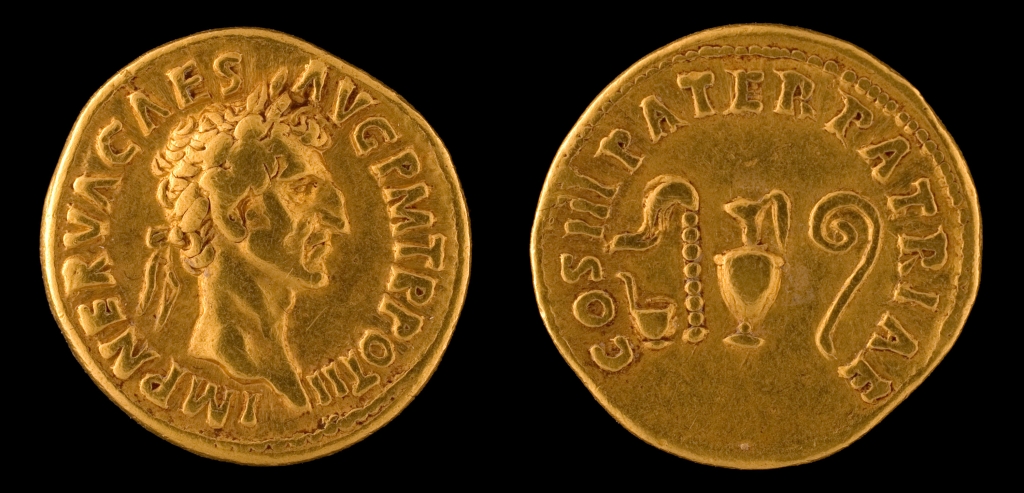
Gold Aureus of Nerva, 7.46 g.
Title
Gold Aureus of Nerva, 7.46 g.
Creator
Nerva
Date
97 CE
Description
Obverse: Laureate head of Nerva facing right; IMP(ERATOR) NERVA CAES(AR) AVG(VSTVS) P(ONTIFEX) M(AXIMVS) TR(IBVNICIA) POT(ESTATE) II: Imperator Nerva Caesar Augustus, pontifex maximus, with tribunician power for the second time.
Reverse: Pontifical intruments; CO(N)S(VL) III PATER PATRIAE: consul for the third time, father of the country.
Style/Period: Roman Empire
Following the murder of the hated Domitian, the elderly and distinguished senator M. Cocceius Nerva was made emperor. Widely admired for his justice and experience, he was a safe choice in the troubled times. Nerva was a mild-mannered emperor whose reign was peaceful and beneficent, particularly concerned with programs for improving the lot of the poor. His wise choice of Trajan as his successor is often considered his greatest achievement. Nerva died of natural causes after only sixteen months in power.
Nerva's coin portraits display an odd mixture of idealization, in the form of a healthy Julio-Claudian head of hair, and harsh realism, in his distinctive profile with its sloping forehead, large hooked nose, and prominent Adam's apple.
The reverses of Nerva's coins use for the most part conservative, general types proclaiming peace, justice, and piety. The priestly instruments depicted here, a simpulum or ladle, sprinkler, jug, and lituus or augur's staff, were often used as tokens of the emperor's status as pontifex maximus, chief priest of the Roman state.
-- Carol L. Lawton
Bibliography: H. Mattingly and E.A. Sydenham, The Roman Imperial Coinage II: Vespasian to Hadrian (London 1926) 34.
Source
Former collection of Ottilia Buerger. Purchased from Abner Kreisberg, 1960.
Identifier
91.156
Rights
Wriston Art Center Galleries, Lawrence University, Appleton, WI,wriston-gallery@lawrence.edu,920-832-6890
Subject
Roman, Empire, Nerva, simpulum, sprinkler, jug, and lituus
Files
Citation
Nerva, “Gold Aureus of Nerva, 7.46 g.,” Lawrence University Classics Department & Ottilia Buerger Coin Collections, accessed November 5, 2026, https://thor.lawrence.edu/omeka/buerger/items/show/274.