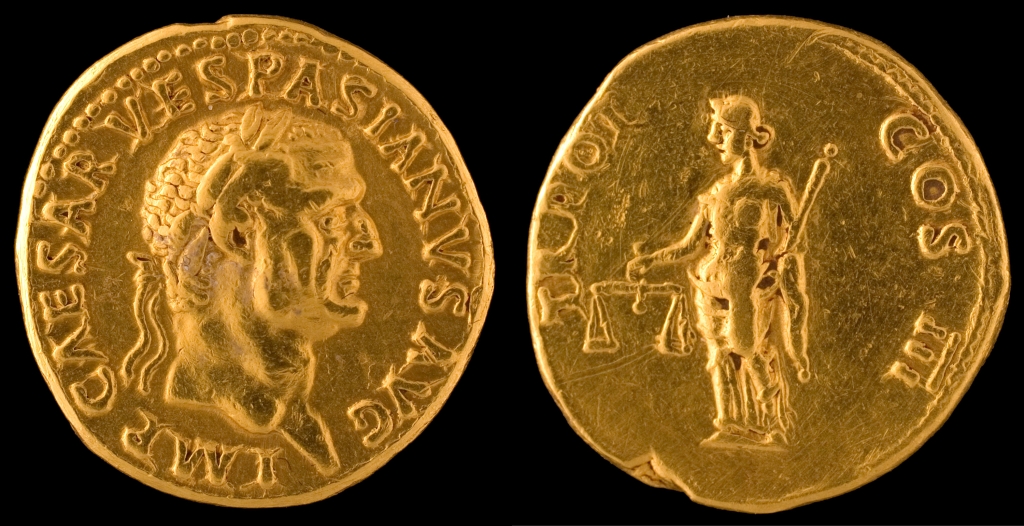
Gold Aureus of Vespasian, 7.22 g.
Title
Gold Aureus of Vespasian, 7.22 g.
Creator
Vespasian
Date
71 CE
Description
Obverse: Laureate head of Vespasian facing right; IMP(ERATOR) CAESAR VESPASIANVS AVG(VSTVS): Imperator Caesar Vespasianus Augustus.
Reverse: Aequitas standing facing left, with scale in right hand and rod in left hand; TR(IBVNICIA) POT(ESTATE) CO(N)S(VL) III: with tribunician power, consul for the third time.
Style/Period: Roman Empire
The emperor Vespasian (Titus Flavius Vespasianus) had a successful military career under Claudius and Nero. He was the last of four men acclaimed emperor in the troubled year 68-69 CE, and with his sons, Titus and Domitian, he founded a new dynasty, the Flavians. Because he came into power following a period of unrest and because he intended some necessary and unpopular reforms, Vespasian was careful to dissociate himself from his discredited predecessors and to undertake works for the benefit of the Roman public. He continued the reconstruction of part of the city that burned in the fire of 64 CE, he began the Flavian Amphitheater (later known as the Colosseum) as an arena for public entertainment on land reclaimed from Nero's extravagant estate, and he completed the Temple of Divine Claudius, which Nero had failed to finish, as a way of dissociating himself from Nero while paying homage to the rest of the Julio-Claudians.
Vespasian's portraits, like those of Galba and Vitellius, break with the Julio-Claudian tradition and return to a harsh realism reminiscent of the veristic portraits of the late republic (see 91.106), no doubt as a further means of dissociating himself from Nero. Vespasian was sixty when he became emperor, and in his portraits he looks his age, heavy-set and bald, with a broad, deeply lined forehead, deep creases around his eyes and mouth, and lines ringing his neck. His tight-lipped mouth, hooked nose, and protruding chin give him a tough look.
The reverse of his coin depicts Aequitas, the personification of equity or fairness, particularly in business transactions. Here she appears with her usual attributes, the scales and measuring rod that ensure fair transactions. Her appearance on the coins of Vespasian at this time probably refers to the fair administration of grain distribution.
-- Carol L. Lawton
Bibliography: H. Mattingly and E.A. Sydenham, The Roman Imperial Coinage II: Vespasian to Hadrian (London 1926) 12.
Source
Former collection of Ottilia Buerger. Bought from Coin Galleries, 1959.
Identifier
91.147
Rights
Wriston Art Center Galleries, Lawrence University, Appleton, WI,wriston-gallery@lawrence.edu,920-832-6890
Subject
Roman, Empire, Vespasian, Aequitas, scale
Files
Citation
Vespasian, “Gold Aureus of Vespasian, 7.22 g.,” Lawrence University Classics Department & Ottilia Buerger Coin Collections, accessed November 5, 2026, https://thor.lawrence.edu/omeka/buerger/items/show/267.