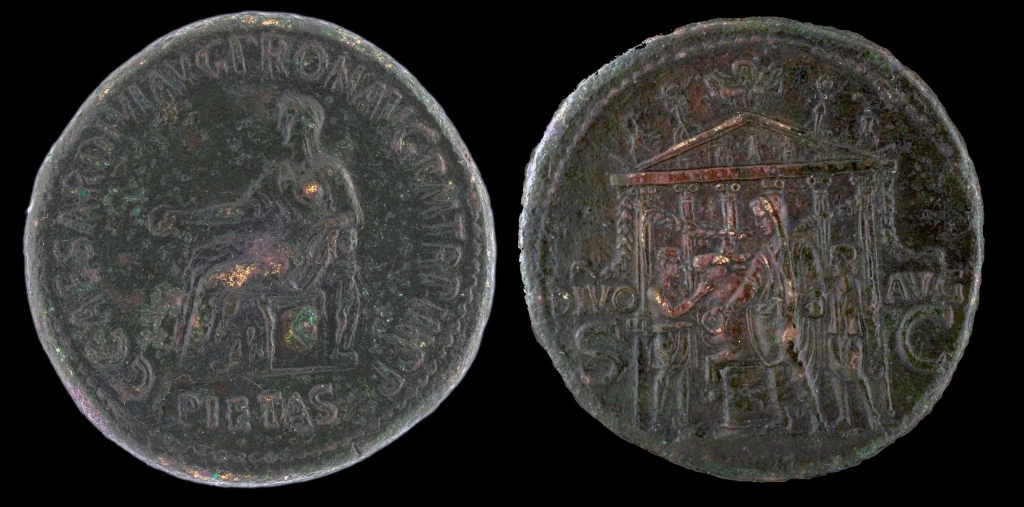
(Copper/bronze/brass) Sestertius of Gaius (Caligula), 27.44 g.
Title
(Copper/bronze/brass) Sestertius of Gaius (Caligula), 27.44 g.
Creator
Gaius Germanicus (Caligula)
Date
39-40 CE
Description
Obverse: Draped and veiled Pietas seated facing left, holding patera in right and resting left on small figure forming part of seat; C(AIVS) CAESAR DIVI AVG(VSTI) PRON(EPOS) AVG(VSTVS) P(ONTIFEX) M(AXIMVS) TR(IBVNICIA) P(OTESTATE) III P(ATER) P(ATRIAE): Gaius Caesar, great-grandson of Divine Augustus, Augustus, pontifex maximus, with tribunician power for the third time, father of the country; in exergue, PIETAS: Pietas.
Reverse: Before hexastyle garlanded temple surmounted by quadriga, Gaius, togate and veiled, sacrifices with patera over garlanded altar; attendant to left leads bull to altar; attendant to right holds patera; DIVO-AVG(VSTO): to Divine Augustus; S(ENATVS)- C(ONSVLTO): by decree of the Senate.
Style/Period: Roman Empire
The emperor Tiberius was succeeded by Gaius Julius Caesar Germanicus, the only male member of the family of the popular Germanicus to survive the plots of Tiberius and his adviser, Sejanus, who had feared their interference with the succession. Officially known as Gaius Caesar, he accompanied his father on his assignment at the Rhine frontier, where the soldiers nicknamed him Caligula or Little Boot for the miniature military outfit he wore there. As emperor he became increasingly autocratic, cruel, and extravagant, and his troops assassinated him in 41 CE.
Few of Caligula's coins refer to specific events in his reign, emphasizing instead his family and particularly his relationship to Augustus. On the obverse of this sestertius the usual portrait of the emperor has been replaced by the personification Pietas, who refers particularly to the obligation to honor the family. The legend specifically identifies Caligula's relationship to Augustus, and on the reverse the emperor sacrifices to Augustus in front of the Temple of Divine Augustus, which was begun by Tiberius but dedicated by Caligula in 37 CE. This coin type was first issued in 37 CE to commemorate the dedication of the temple and later revived.
-- Carol L. Lawton
Bibliography: C.H.V. Sutherland, The Roman Imperial Coinage I: from 31 BC to AD 69, rev. ed. (London 1984) 44; P.V. Hill, The Monuments of Rome as Coin Types (London 1989) 19-21.
Source
Former collection of Ottilia Buerger. Bought from Coin Galleries, August 12, 1959.
Identifier
91.128
Rights
Wriston Art Center Galleries, Lawrence University, Appleton, WI,wriston-gallery@lawrence.edu,920-832-6890
Subject
Roman, Empire, Pietas, patera, temple, quadriga, Gaius, Caligula, sacrifice, altar, bull
Files
Citation
Gaius Germanicus (Caligula), “(Copper/bronze/brass) Sestertius of Gaius (Caligula), 27.44 g.,” Lawrence University Classics Department & Ottilia Buerger Coin Collections, accessed November 5, 2026, https://thor.lawrence.edu/omeka/buerger/items/show/264.