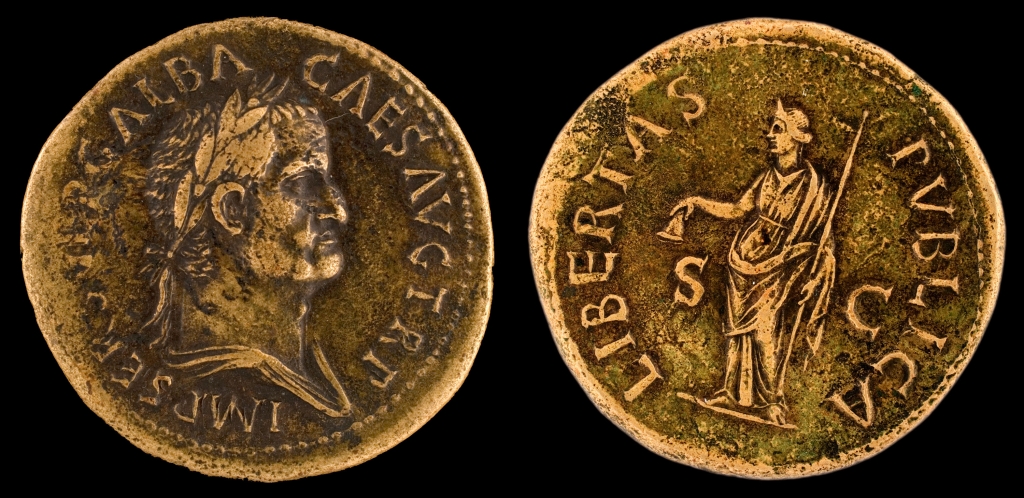
(Copper/bronze/brass) Sestertius of Galba, 26.27 g.
Title
(Copper/bronze/brass) Sestertius of Galba, 26.27 g.
Creator
Galba
Date
69 CE
Description
Obverse: Draped and laureate bust of Galba facing right; IMP(ERATOR) SER(VIVS) SVLP(ICIVS)GALBA CAES(AR) AVG(VSTVS) TR(IBVNICIA) P(OTESTATE): ImperatorServius Sulpicius Galba, Caesar, Augustus, with tribunician power.
Reverse: Libertas standing facing left, draped and holding pileus in right and scepter in left; LIBERTAS PVBLICA: Liberty of the public; S(ENATVS)-C(ONSVLTO): by decree of the Senate.
Style/Period: Roman Empire
Servius Sulpicius Galba, who was born into an old aristocratic family and who had served as governor in Germany and Spain, joined the revolt against Nero, was hailed imperator by his troops, and assumed the title Augustus on the death of Nero. He was murdered by his troops after a reign of only about eight months.
Galba issued coins during the revolt, before he had been confirmed as Augustus by the Senate, and these featured types and slogans of the revolt promising the restitution of Rome and of liberty. This coin, issued after Galba had become emperor, still has some of that character, with its reverse depicting Libertas Publica. Libertas had been worshipped in the republic as the personification of personal liberty, but in the empire she stood for liberation from tyranny. Here she holds her usual attributes, a scepter and a pileus, a conical cap given to slaves when they received their freedom.
Galba's portrait on the obverse shows that he rejected the youthful classicism of the Julio-Claudians and the flourishes of Nero for an uncompromising realism perhaps meant to recall the verism of the late republic and to appeal to the military upon which his power depended. He was already over seventy when he became emperor, and he is depicted as elderly, with a lined forehead, bags under his eyes, and sagging jowls.
-- Carol L. Lawton
Bibliography: C.H.V. Sutherland, The Roman Imperial Coinage I: from 31 BC to AD 69, rev. ed. (London 1984) 309.
Source
Former collection of Ottilia Buerger. Bought from Coin Galleries, March 11, 1960.
Identifier
91.143
Rights
Wriston Art Center Galleries, Lawrence University, Appleton, WI,wriston-gallery@lawrence.edu,920-832-6890
Subject
Roman, Empires, Galba, Libertas, pileus, scepter
Files
Citation
Galba, “(Copper/bronze/brass) Sestertius of Galba, 26.27 g.,” Lawrence University Classics Department & Ottilia Buerger Coin Collections, accessed November 5, 2026, https://thor.lawrence.edu/omeka/buerger/items/show/256.