(Copper/bronze/brass) Sestertius of Nero, 26.40 g.
Title
(Copper/bronze/brass) Sestertius of Nero, 26.40 g.
Creator
Nero
Date
64-66 CE
Description
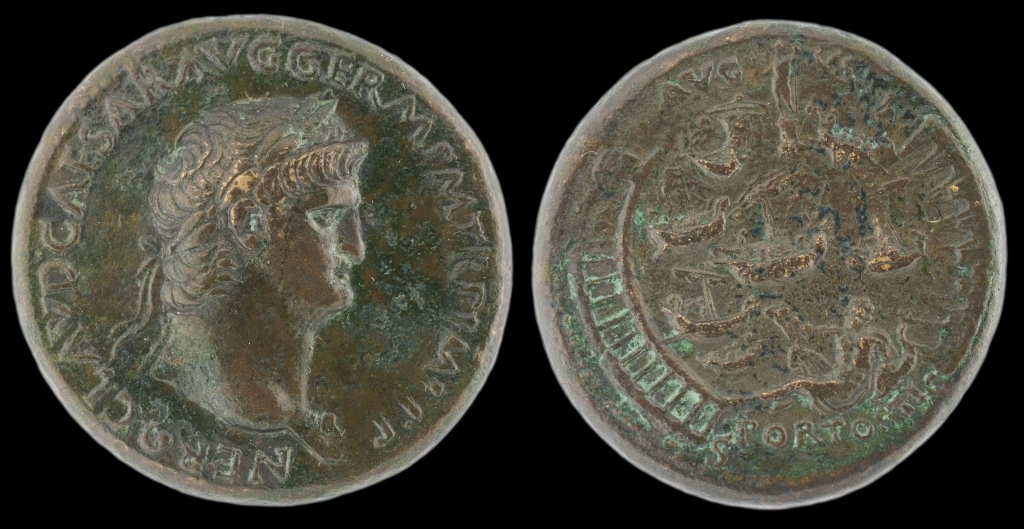
Obverse: Laureate bust of Nero facing right; NERO CLAVD(IVS) CAESAR AVG(VSTVS) GERM(ANICVS) P(ONTIFEX) M(AXIMVS) TR(IBVNICIA) P(OTESTATE) IMP(ERATOR) P(ATER) P(ATRIAE): Nero Claudius Caesar Augustus Germanicus, pontifex maximus, with tribunician power, imperator, father of the country.
Reverse: Bird's-eye view of the port of Ostia. At top, lighthouse surmounted by statue of Neptune left, holding scepter; at bottom, reclining figure of Tiber left, holding rudder in right and dolphin in left; to left, crescent-shaped pier with portico; to right, crescent-shaped row of slips; in center, seven ships; PORT(VS) OST(IENSIS) AVGVSTI: the port of Augustus of Ostia; S(ENATVS)-C(ONSVLTO): by decree of the Senate.
Style/Period: Roman Empire
One consequence of the emperor Nero's monetary reform of c. 64 CE (see 91.134) was the reintroduction of the bronze sestertius, which had been suspended since the time of the emperor Claudius. These large coins provided Nero's die-engravers with opportunities to develop not only fine portraits for the obverses but also very detailed reverses designed to remind people of the emperor's good qualities and the services he provided to the people of Rome.
The reverse of this sestertius commemorates the expansion of the Roman port of Ostia. The work was begun by Claudius in 42 CE, in order to provide year-round deliveries of grain. The harbor was dedicated in 54 CE, but ten years later Nero made it part of an ambitious plan to connect Lake Avernus to Ostia with a 125-mile long canal, a project never completed. The port itself is depicted with a wealth of detail, not all of which is legible on this coin. The porticoes of the pier on the left probably represent the warehouses and offices through which the city's imported grain supply passed. The slips on the right may represent the docking area. In the harbor large and small ships come and go under the watchful eyes of the statue of Neptune, god of the sea, and a personification of the river Tiber.
--Shannon Gaylord Bakich-Grasser, LU '92
Bibliography: C.H.V. Sutherland, The Roman Imperial Coinage I: from 31 BC to AD 69, rev. ed. (London 1984) 180.
Source
Former collection of Ottilia Buerger. Bought from Coin Galleries, August 12, 1959.
Identifier
91.141
Rights
Wriston Art Center Galleries, Lawrence University, Appleton, WI,wriston-gallery@lawrence.edu,920-832-6890
Subject
Roman, Empire, Nero, port, Ostia, lighthouse, statue, Neptune, scepter, Tiber, personification, rudder, dolphin, pier, slips, ships
Files
Citation
Nero, “(Copper/bronze/brass) Sestertius of Nero, 26.40 g.,” Lawrence University Classics Department & Ottilia Buerger Coin Collections, accessed November 5, 2026, https://thor.lawrence.edu/omeka/buerger/items/show/254.