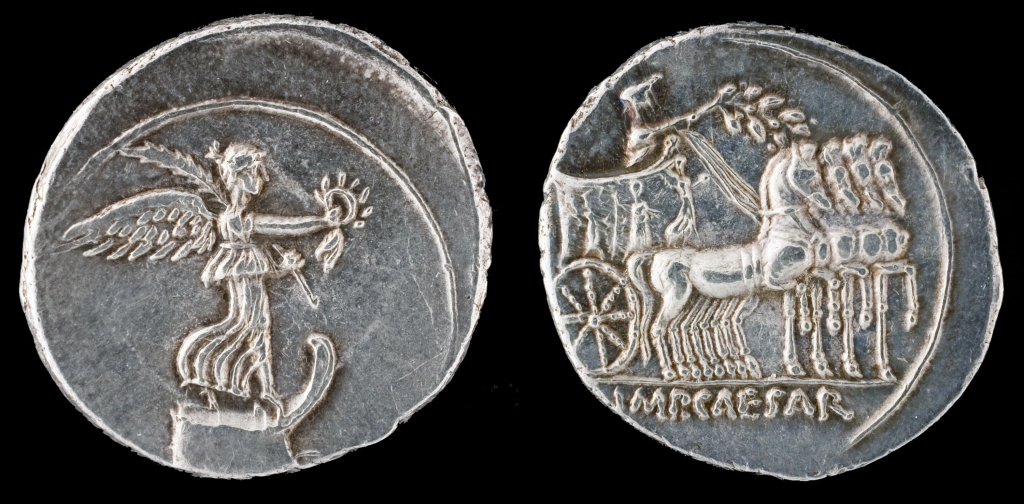
Silver Denarius of Octavian, 3.86 g.
Title
Silver Denarius of Octavian, 3.86 g.
Creator
Octavian
Date
c. 29-27 BCE
Description
Obverse: Victoria standing to right on prow, holding wreath in right and palm in left
Reverse: Octavian, holding olive branch, in triumphal quadriga to right; IMP(ERATOR) CAESAR: Imperator Caesar.
Style/Period: Roman Republic
In 31 BCE Octavian, the great-nephew and adopted heir of Julius Caesar, brought an end to the civil wars that had plagued the late Roman republic since the assassination of Caesar when his forces defeated the huge navy of his rival Marc Antony and Kleopatra of Egypt and he emerged as sole ruler of Rome. The rival leaders had for some time issued their own coins to finance their military needs, and Octavian continued to do so, but from the time he was given the honorific title Augustus and constitutional imperial power by the Senate in 27 BCE, he gradually took control of Roman coinage and its institutions and established the model for the coinage that served the Roman empire for the next three centuries. The coin types that he and his successors used were meant to inform the better educated Roman public of their achievements and various aspects of imperial policy.
This coin, issued by Octavian before he received his title and position in 27 BCE, seems somewhat old-fashioned in that it does not depict his portrait. The head of the issuer first appeared on the coins of Julius Caesar in 44 BCE (see 91.106). A portrait quickly became the popular obverse of the rivals in the civil war that followed Caesar's assassination and would eventually become the norm for imperial coinage. But both the obverse and reverse of this coin feature types referring to Octavian's victory over Antony and Kleopatra. Victoria on a ship's prow on the obverse refers to naval victory, specifically Octavian's defeat of Antony's fleet in the Battle of Actium. But the depiction of Octavian in a triumphal quadriga on the reverse indicates that the coin actually dates from his triple triumph (for his victories in Illyricum and Egypt, as well as in the battle of Actium) in Rome in 29 BCE, when the Senate conferred numerous honors upon him.
-- Carol L. Lawton
Bibliography: C.H.V. Sutherland, The Roman Imperial Coinage I: from 31 BC to AD 69, rev. ed. (London 1984) 264.
Source
Former collection of Ottilia Buerger. Bought from Hesperia Art, Mar. 1959.
Identifier
91.107
Rights
Wriston Art Center Galleries, Lawrence University, Appleton, WI,wriston-gallery@lawrence.edu,920-832-6890
Subject
Roman, Republic, Victoria, prow, wreath, Octavian, olive branch, quadriga,
Files
Citation
Octavian, “Silver Denarius of Octavian, 3.86 g.,” Lawrence University Classics Department & Ottilia Buerger Coin Collections, accessed November 5, 2026, https://thor.lawrence.edu/omeka/buerger/items/show/237.