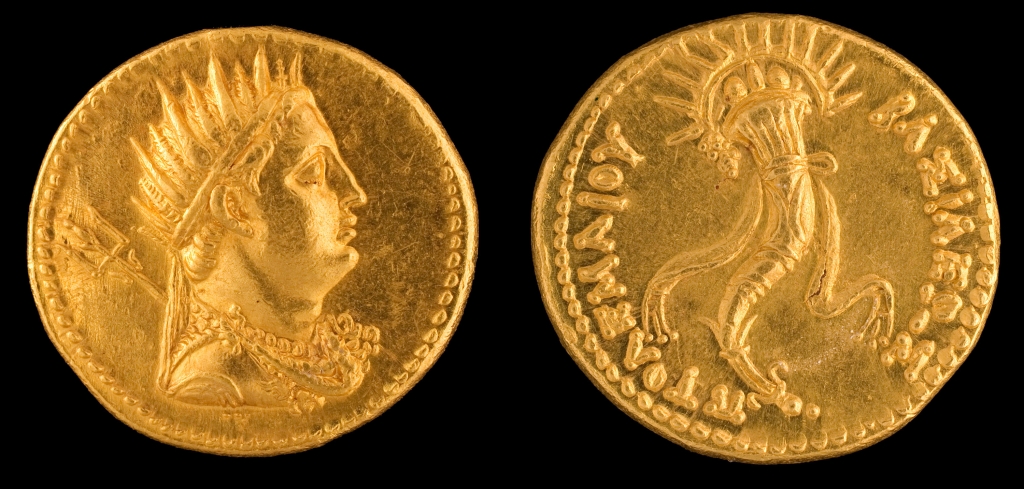
Gold Octodrachm of Ptolemy IV Philopator, Egypt, 27.82 g.
Title
Gold Octodrachm of Ptolemy IV Philopator, Egypt, 27.82 g.
Creator
Ptolemy IV Philopator, Egypt
Date
c. 221-205 BCE
Description
Obverse: Bust of Ptolemy III facing right., wearing radiate diadem and aegis, scepter-trident behind shoulder.
Reverse: Radiate cornucopia bound with fillet; ΠΤΟΛΕΜΑΙΟΥ ΒΑΣΙΛΕΩΣ: of King Ptolemy.
Style/Period: Hellenistic
This coin depicting Ptolemy III Euergetes (Benefactor) was issued by his successor, Ptolemy IV Philopator (Father-lover), as a gesture of dynastic continuity and of the filial piety that his name implies. Ptolemy III was the son of Ptolemy II and Arsinoe II. He married his cousin Berenike II, princess of Kyrene, thereby reuniting Egypt with Kyrene, which Ptolemy II had lost. He carried on a successful war against Syria and acquired important cities in Asia Minor and Thrace.
The portrait on the obverse confers upon Ptolemy III several attributes of divinity. He wears the aegis associated with Zeus that had been an attribute of Ptolemy I Soter (see 91.096). The trident that forms part of his scepter alludes to Poseidon, god of the sea, and to Ptolemaic naval power, which was at its height under Ptolemy III. The radiate diadem on the portrait head and the rays over the cornucopia on the reverse refer to the sun god, Helios. The cornucopia itself refers to the abundance and prosperity of Egypt.
-- Kristin J. Brainard Addington, LU '94
Bibliography: J. Svoronos, Ta Nomismata tou Kratous ton Ptolemaion 2 (Athens 1904) 1131, pl. 36.4; O. Mørkholm, Early Hellenistic Coinage from the Accession of Alexander to the Peace of Apamea (336-188 B.C.) (Cambridge 1991) 108-109.
Source
Former collection of Ottilia Buerger. Bought from Numismatic Fine Arts, 1989.
Identifier
91.100
Rights
Wriston Art Center Galleries, Lawrence University, Appleton, WI,wriston-gallery@lawrence.edu,920-832-6890
Subject
Hellenistic, Ptolemy III, diadem, aegis, scepter-tri, cornucopia, Ptolemy IV Philopator, Egypt
Files
Citation
Ptolemy IV Philopator, Egypt, “Gold Octodrachm of Ptolemy IV Philopator, Egypt, 27.82 g.,” Lawrence University Classics Department & Ottilia Buerger Coin Collections, accessed November 5, 2026, https://thor.lawrence.edu/omeka/buerger/items/show/233.