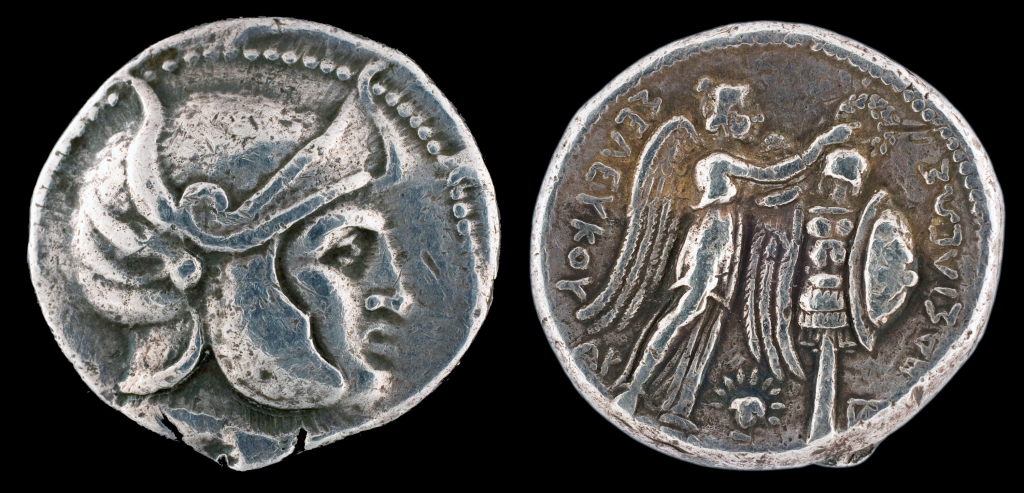
Silver Tetradrachm of Seleukos (Seleucus) I Nikator, Syria, 17.0 g.
Title
Silver Tetradrachm of Seleukos (Seleucus) I Nikator, Syria, 17.0 g.
Creator
Seleukos (Seleucus) I Nikator, Syria
Date
c. 301 BCE
Description
Obverse: Head of Seleukos or Alexander facing right, wearing helmet of leopard skin adorned with horn and ear of bull.
Reverse: Nike crowning trophy of armor to right.; head of Helios below; monogram in right field; ΒΑΣΙΛΕΩΣ ΣΕΚΕΥΚΟΥ: of King Seleukos.
Style/Period: Hellenistic
Seleukos I Nikator (Conqueror) was one of the generals of Alexander the Great and assumed control of Babylon after Alexander's death. By degrees he became ruler of Alexander's eastern dominions, with the exception of Egypt, defeating his rivals Demetrios and Lysimachos. In 305/04 BCE he assumed the title of basileus or king. Like the other successors of Alexander, Seleukos I initially issued coins with the types used in Alexander's coinage, but like the others also he soon issued coins with his own types and in his own name.
The date and even the interpretation of these tetradrachms that he issued at Susa are uncertain. The youthful head on the obverse may be an idealized head of Seleukos incorporating some aspects of Alexander's portrait, but it has also been suggested that it is Alexander himself. The leopardskin of the helmet refers to the god Dionysos, whose attribute was a leopard and who, like Alexander and Seleukos, conquered India. The helmet recalls the lionskin cap worn by Herakles on coins of Alexander, and the bull's ear and horn recall similar divine attributes in portraits of Alexander (see 91.046).
The reverse has also been variously interpreted. The trophy crowned by Nike consists of a tree trunk hung with a cuirass or breastplate, a helmet, and a shield, clear references to military victory. It is usually taken to refer to Seleukos' important victory over Antigonos Monophthalmos at the Battle of Ipsos in 301 BCE, but it has also been seen as a generalized reference to Alexander's and Seleukos' Indian victories.
-- Kristin J. Brainard Addington, LU '94
Bibliography: R.A. Hadley, "Seleucus, Dionysos, or Alexander?," Numismatic Chronicle 1974, 9-13; O. Mørkholm, Early Hellenistic Coinage from the Accession of Alexander to the Peace of Apamea (336-188 B.C.) (Cambridge 1991) 72.
Source
Ottilia Buerger Collection bought from Hesperia Art, March 18, 1961.
Identifier
91.089
Rights
Wriston Art Center Galleries, Lawrence University, Appleton, WI,wriston-gallery@lawrence.edu,920-832-6890
Subject
Hellenistic, Seleukos or Alexander, helmet, leopard skin, horn, Nike,armor, Helios, Seleukos I, Seleucus ,I Nikator, Syria
Files
Citation
Seleukos (Seleucus) I Nikator, Syria, “Silver Tetradrachm of Seleukos (Seleucus) I Nikator, Syria, 17.0 g.,” Lawrence University Classics Department & Ottilia Buerger Coin Collections, accessed November 5, 2026, https://thor.lawrence.edu/omeka/buerger/items/show/223.