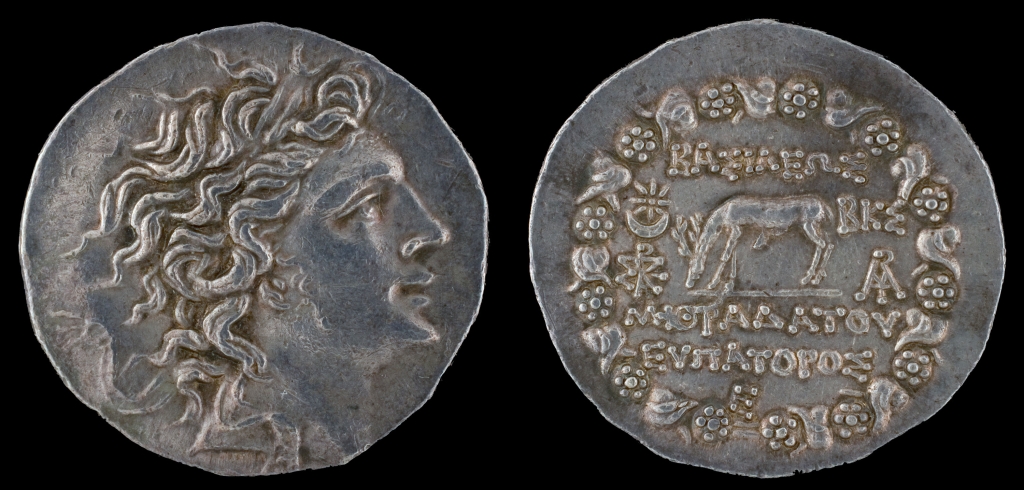
Silver Tetradrachm of Mithradates VI the Great Eupator, Pontus (Pontos), 16.78 g.
Title
Silver Tetradrachm of Mithradates VI the Great Eupator, Pontus (Pontos), 16.78 g.
Creator
Mithradates VI the Great Eupator, Pontus (Pontos)
Date
75 BCE
Description
Obverse: Diademed head of Mithradates facing right.
Reverse: In ivy wreath, grazing stag facing to left; in left field, star and crescent above monogram; in right field, BKS (date of the Bithynian Era = 75 B.C.) above monogram; ΒΑΣΙΛΕΩΣ ΜΙΘΡΑΔΑΤΟΥ ΕΥΠΑΤΟΡΟΣ: of King Mithradates Eupator.
Style/Period: Hellenistic
Mithradates was a bitter enemy of Rome, with whom he fought three wars between 88 and 63 BCE He saw himself as the protector of the Greeks, who initially welcomed his attempts to stave off the Romans, but in the end his rule was oppressive, and he met resistance even in his own territory. At the height of his power he controlled much of Asia Minor and Greece, choosing Pergamon as his capital and royal residence. Rome eventually forced him to give up his conquered territory, pay a huge indemnity, and retreat to his original borders. He committed suicide in 63 BCE.
Since most of Mithradates' coins are dated, the origin of the types on this tetradrachm can be traced to 89/88 BCE, the year of his great invasion of Asia Minor. The clearly idealized portrait of Mithradates on the obverse makes a sharp break with the hard-bitten, realistic style of his predeces sors' portraits (see 93.011). In contrast to their foreign features, short beards, and long sideburns, Mithradates, over fifty at the time, appears youthful, clean-shaven, and Hellenized, with the flowing hair and upward gaze associated above all with portraits of Alexander the Great (see 91.046). The portrait type was probably intended to appeal to the Greeks of Asia Minor, to whom he wanted to appear as their saviour, the new Alexander.
The stag on the reverse, an attribute of the Greek goddess Artemis, may have been intended to refer to her major cult and sanctuary in Ephesos in Asia Minor and thus again to appeal to the Greeks of the area. The star and crescent, perhaps a family device, represent the sun and moon and allude to the Persian worship of celestial bodies. The ivy wreath refers to Dionysos, Mithradates' patron deity, a Greek god but one associated with the East.
-- Kristin J. Brainard Addington, LU '94
Bibliography: M.J. Price, "Mithradates VI Eupator, Dionysus, and the Coinages of the Black Sea," Numismatic Chronicle, 7th series, 8 (1968) 1-12.
Source
Ottilia Buerger bought from Edward Gans, March, 1959.
Identifier
91.078
Rights
Wriston Art Center Galleries, Lawrence University, Appleton, WI,wriston-gallery@lawrence.edu,920-832-6890
Subject
Hellenistic, diadem, Mithradates, ivy wreath, stag, star, crescent, Mithradates VI the Great Eupator, Pontus (Pontos)
Files
Citation
Mithradates VI the Great Eupator, Pontus (Pontos), “Silver Tetradrachm of Mithradates VI the Great Eupator, Pontus (Pontos), 16.78 g.,” Lawrence University Classics Department & Ottilia Buerger Coin Collections, accessed November 5, 2026, https://thor.lawrence.edu/omeka/buerger/items/show/221.