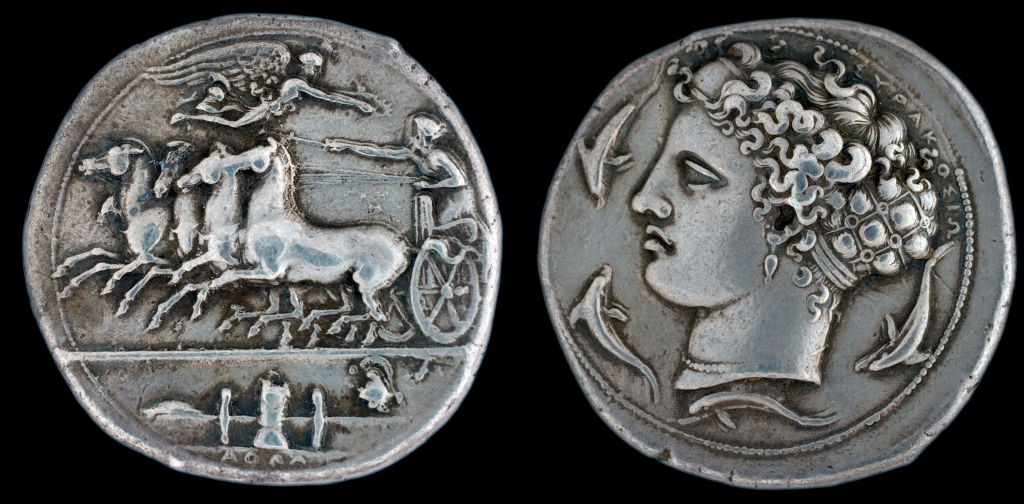
Silver Dekadrachm of Syracuse, Sicily, Italy, 43.15 g.
Title
Silver Dekadrachm of Syracuse, Sicily, Italy, 43.15 g.
Creator
Syracuse, Sicily, Italy
Date
c. 405-400 BCE
Description
Obverse: Victorious quadriga facing left; cuirass, helmet, shield, and greaves in exergue; below, ΑΘΛΑ: prizes.
Reverse: Head of Arethusa facing left, with band and net holding hair, surrounded by four dolphins; ΣΥΡΑΚΟΣΙΩΝ: of the Syracusans.
Style/Period: Greek (ancient)
This coin is attributed to the master engraver Kimon, whose works, like those of the other great Syracusan engraver, Euainetos, were imitated by the mints of other cities. The obverse, as in the reverse of his dekadrachm with the facing Arethusa (see 91.007), depicts a racing quadriga. The charioteer and the front horse cross the beaded outline of the coin and seem to break free of the framing constraints. The composition has smooth modeling and intricate details.
The military equipment along with the word "prizes" in the exergue had long led numismatists to associate them with the booty awarded as prizes in games celebrating the Syracusan victory over Athens in 413 BCE There is, however, no evidence for the games, and it is now generally believed that the coins are later, possibly issued by Dionysios I to celebrate the failed Carthaginian attack on Syracuse in 405 BCE
On the reverse is the Syracusan nymph Arethusa, for whom the fresh water spring on the Syracusan island of Ortygia was named. The dolphins encircling her head probably refer to the location of the spring on the island. On this coin Arethusa wears an ampyx or hairband, on which Kimon frequently signed his name, and has the rest of her hair caught up in an intricate net.
-- Kelly Swett Riordan, LU '93
Bibliography: G.E. Rizzo, Monete greche della Sicilia (Rome 1946), 50.6; J.H. Jongkees, The Kimonian Decadrachms (Utrecht 1941) 11.
Source
Former collection of Ottilia Buerger. Ex Pennisi collection; Bank Leu, 1973.
Identifier
91.033
Rights
Wriston Art Center Galleries, Lawrence University, Appleton, WI,wriston-gallery@lawrence.edu,920-832-6890
Subject
Greek, horse, quadriga, cuirass, helmet, shield, greaves, Arethusa, dolphins, Syracuse, Sicily, Italy
Files
Citation
Syracuse, Sicily, Italy, “Silver Dekadrachm of Syracuse, Sicily, Italy, 43.15 g.,” Lawrence University Classics Department & Ottilia Buerger Coin Collections, accessed November 5, 2026, https://thor.lawrence.edu/omeka/buerger/items/show/212.