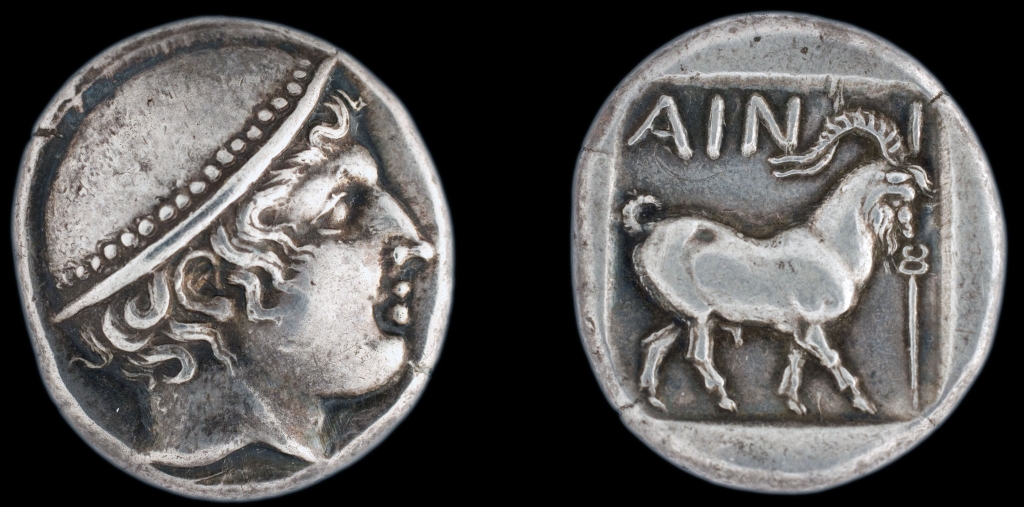
Silver Tetradrachm of Aenus (Ainos), Thrace, Turkey, 16.44 g.
Title
Silver Tetradrachm of Aenus (Ainos), Thrace, Turkey, 16.44 g.
Creator
Aenus (Ainos), Thrace, Turkey
Date
c. 412-410 BCE
Description
Obverse: Head of Hermes wearing petasos facing right
Reverse: In incuse, goat facing right; kerykeion in right field; ΑΙΝΙ: abbreviation for "of the Ainians."
Style/Period: Greek (ancient)
Ainos was a Greek colony on the northeastern coast of the Aegean. Its location on the mouth of the river Hebros made it an important shipping center for agricultural exports from the interior of Thrace. Though not the first in eastern Thrace, its mint dominated regional coinage soon after its first issues c. 475 BCE. From the beginning its die-cutters rejected the usual animal types used by most mints of the area and instead used a series of beautiful heads of the chief god of Ainos, Hermes, as its obverse type.
Hermes, the messenger god and patron of merchants and herdsmen, was probably worshiped at Ainos from early times. According to legend, a wooden statue of the god washed ashore at the mouth of the Hebros, where local fishermen caught it in their nets. They failed to recognize it and threw it back into the sea, only to catch it again. The statue was finally set up in a sanctuary, and an oracle of Apollo told Ainos to worship it along with the local gods. An armless and legless image on the reverse of some coins of Ainos is probably meant to represent the primitive statue. As the god of the marketplace and commerce, Hermes is also appropriate to Ainos. On this coin he wears his characteristic petasos or broad-rimmed hat.
The reverse depicts a goat, reference to Hermes' role as the divine herdsman. In front of it is a kerykeion, Hermes' heraldic staff, one of a number of symbols on the reverses which changed with each issue.
--Peter A. Martens, LU '96
Bibliography: J.M.F. May, Ainos, its history and coinage (Oxford 1950).
Source
Former collection of Ottilia Buerger. From Edward Gans Mail Bid Sale no. 16, April 29, 1960.
Identifier
91.044
Rights
Wriston Art Center Galleries, Lawrence University, Appleton, WI,wriston-gallery@lawrence.edu,920-832-6890
Subject
Greek, god, Hermes, petasos, goat, kerykeion, Aenus, Ainos, Thrace, Turkey
Files
Citation
Aenus (Ainos), Thrace, Turkey, “Silver Tetradrachm of Aenus (Ainos), Thrace, Turkey, 16.44 g.,” Lawrence University Classics Department & Ottilia Buerger Coin Collections, accessed November 5, 2026, https://thor.lawrence.edu/omeka/buerger/items/show/177.