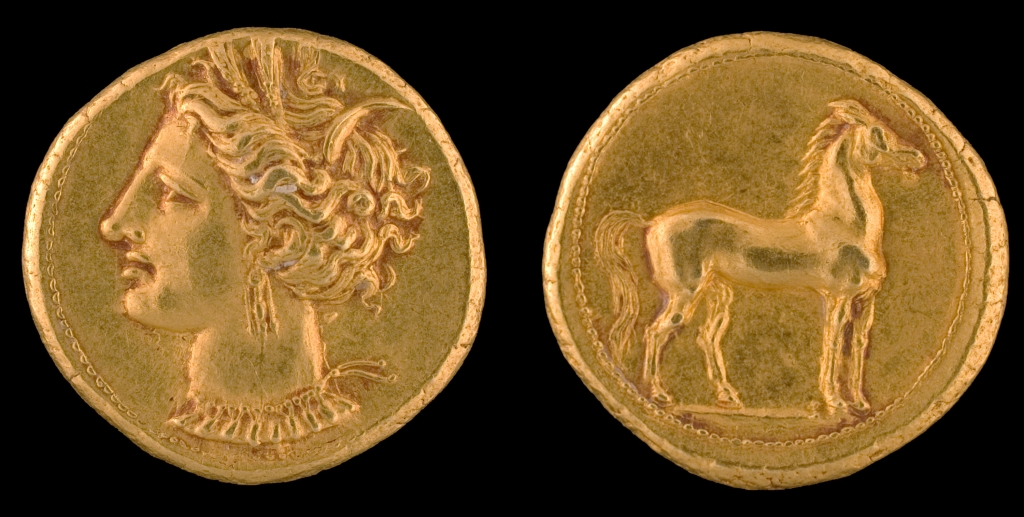
Electrum Stater of Carthago (Carthage), Zeugitana, Tunisia, 7.60 g.
Title
Electrum Stater of Carthago (Carthage), Zeugitana, Tunisia, 7.60 g.
Creator
Carthage, Zeugitana, Tunisia
Date
320-310 BCE
Description
Obverse: Head of Tanit/Demeter/Persephone facing left, wearing triple-drop earring, pendant necklace, and wreath of grain.
Reverse: Standing horse facing right; two pellets behind front legs.
Style/Period: Carthaginian (ancient)
Carthage, the important Phoenician trading city on the northern coast of Africa, first produced silver coins in Sicily in the second half of the fifth century for use in transactions with the Greek colonies there and later for paying its troops attempting to gain control of the island (see 91.041). In contrast to this Siculo-Punic coinage, the coinage of Carthage itself begins only in the early to mid-fourth century, its large denominations entirely gold and electrum.
The images on Carthaginian coinage, like those of the Siculo-Punic issues, are a mixture of Greek and Carthaginian types. The head on the obverse of this stater is usually identified as Tanit, the main deity of Carthage, but the head is clearly based upon the head of the nymph Arethusa by Euainetos on Syracusan dekadrachms (see 91.032). Tanit is the Carthaginian equivalent of Juno. The head has also been identified as Demeter or Persephone, the important agricultural goddesses of Sicily, because, unlike Arethusa, she has ears of grain in her wreath. The cult of Demeter and Persephone was established in Carthage in 396 BCE, in atonement for the destruction of their temples during the Carthaginian invasion of Sicily. The horse appears in various forms on both Carthaginian and Siculo-Punic coins (see 91.041, 91.043). It may refer to the Carthaginian foundation legend, in which the goddess Juno pointed out the future site of Carthage by showing the Phoenicians the spot where they would discover a horse's head in the ground (Virgil, Aeneid 1. 441-44; see 91.041).
-- Kathleen L. Metzger Newmyer, LU '94
Bibliography: G.K. Jenkins and R.B. Lewis, Carthaginian Gold and Electrum Coins (London 1963) 225.
Source
Former collection of Ottilia Buerger. Ex Santa Barbara Museum of Art; Malter, 1975.
Identifier
91.042
Rights
Wriston Art Center Galleries, Lawrence University, Appleton, WI,wriston-gallery@lawrence.edu,920-832-6890
Subject
Carthaginian, gpddess, Tanit, Demeter, Persephone, grain, horse, Carthago, Carthage, Zeugitana, Tunisia
Files
Citation
Carthage, Zeugitana, Tunisia, “Electrum Stater of Carthago (Carthage), Zeugitana, Tunisia, 7.60 g.,” Lawrence University Classics Department & Ottilia Buerger Coin Collections, accessed November 5, 2026, https://thor.lawrence.edu/omeka/buerger/items/show/172.