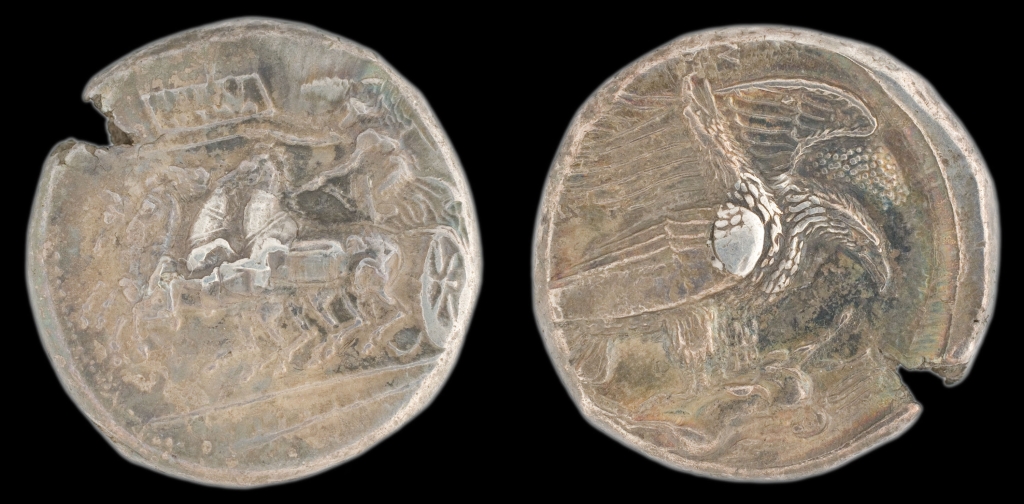
Silver Tetradrachm of Agrigentum (Akragas), Sicily, Italy, 17.42 g.
Title
Silver Tetradrachm of Agrigentum (Akragas), Sicily, Italy, 17.42 g.
Creator
Agrigentum (Akragas), Sicily, Italy
Date
413-406 BCE
Description
Obverse: Racing quadriga to left driven by Nike; tablet above inscribed ΑΚΡΑΓΑΝΤΙΝΟΝ: of the Akragantines; club in exergue.
Reverse: Two eagles devouring a hare facing right.
Style/Period: Greek (ancient)
Akragas, modern Agrigento, was founded c. 580 BCE by settlers from the Rhodian colony of Gela. It was one of the wealthiest cities of Sicily, prospering from its agricultural exports to Carthage. It reached its period of greatest influence under the tyrant Theron, 488-472 BCE, whose building program included a colossal Temple of Olympian Zeus. The city was destroyed by Carthage in 406 BCE.
The eagle, attribute of Zeus, was the most frequent Akragantine coin type. It appeared as a simple standing bird on the obverse of the city's coins until the late fifth century, when under the influence of the coins of Syracuse it was displaced by a victorious quadriga (see 91.032, 91.033, 93.005, 93.007). On the reverses of these coins the tame standing bird of earlier issues was replaced by two mighty eagles devouring a hare. Both eagles stand on their prey, one with spread wings about to pick at the animal, the other raising its head to swallow or scream.
The quadriga on the obverse may originally have referred to an Olympic victory, but it was used for several years. Like its Syracusan model, it is a fast-moving quadriga with spirited horses throwing their heads into the air; one die shows a broken rein trailing on the ground.
-- Carol L. Lawton
Bibliography: C.T. Seltman, "The engravers of the Akragantine decadrachms," Numismatic Chronicle 1948, 1-10.
Source
Former collection of Ottilia Buerger. Purchased from Harlan Berk, 29 Aug 1989.
Identifier
93.010
Rights
Wriston Art Center Galleries, Lawrence University, Appleton, WI,wriston-gallery@lawrence.edu,920-832-6890
Subject
Greek, quadriga, horse, Nike, eagle, hare, Agrigentum, Akragas, Sicily, Italy
Files
Citation
Agrigentum (Akragas), Sicily, Italy, “Silver Tetradrachm of Agrigentum (Akragas), Sicily, Italy, 17.42 g.,” Lawrence University Classics Department & Ottilia Buerger Coin Collections, accessed November 5, 2026, https://thor.lawrence.edu/omeka/buerger/items/show/165.